
Decks vs. Patios: How to Choose the Right Outdoor Space for You
By Dave KileEnhancing your outdoor space with a new deck or new patio is the perfect way to add beauty, enjoyment, and value to your home. These additions not only revamp the look of your outdoor living space in a big way, but they provide the perfect setting to do everything from relaxing in the sun to entertaining friends and family.
However, the terms “patio” and “deck” being used synonymously over the years has led to some confusion about what each one is and what they offer. So, what are the differences between a deck and a patio? And which one is better?
Continue reading below for everything you need to know when considering a deck vs. patio for your next home improvement project. We cover the pros, cons, costs, return on investment (ROI), and everything in between.
What is the Difference Between a Deck and a Patio?

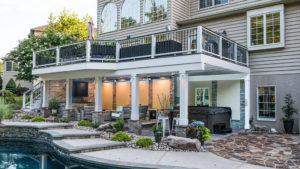
The main difference between a deck and a patio is their relation to the ground, but that distinction affects far more than height alone. A deck is a raised structure supported by posts, beams, and joists, while a patio is built at or near ground level on a prepared base.
The parts of a deck include interconnected framing and structural elements that support the decking and work together as a complete system. This allows decks to be built over uneven terrain, slopes, or changing grades in situations where patios can be more difficult or costly to install.
Patios, by contrast, typically require relatively level ground and depend on soil stability to prevent cracking or shifting over time. While simpler in construction, they don’t offer the same vertical design flexibility or usable space beneath the surface.
Additional Factors to Consider
Material
Wood or composite materials are go-to’s for decks. In contrast, concrete pavers, bricks, and stone slabs are common materials for patios. Each material offers a unique look and has its own pros and cons. For example, concrete is more durable than wood, but it can look industrial and unwelcoming if not accessorized well.
Cost
Patios not only cost less to build initially, but durable materials like stamped concrete and stone also mean fewer maintenance costs. The cost per square foot of a patio often falls in the $15-$50 range, whereas a deck is approximately $25-$55. Keep in mind that costs will vary depending on which materials you choose, the size of the build, and who is building it.
What’s the ROI for a Deck vs. Patio?
According to the 2025 Cost Vs. Value Report by Remodeling, deck projects continue to deliver strong resale performance, with updated national median costs reflecting current construction pricing. In the report, the national median project cost for a wood deck addition is approximately $18,263, while the national median cost for a composite deck addition is approximately $25,096. At resale, wood decks recoup about 65% of their cost, and composite decks recoup about 63%.
The Remodeling Impact Report from the National Association of Realtors continues to show even higher perceived value for decks in real-world resale scenarios. The recent report estimates that homeowners typically recover about 82% of the cost of a new wood deck at resale, based on a standard deck attached to the home with a ledger. From that same report, a concrete paver patio recovers an estimated 69% of its cost, reflecting solid but lower returns compared to elevated decks.
What are the Pros and Cons of Decks and Patios?
Beyond where they sit in relation to the ground, their strengths and shortcomings are what sets decks and patios apart. Here are the pros and cons that every homeowner should consider when deciding between these two hardscaping projects.
Decks
| Pros | Cons |
|
|
Patios
| Pros | Cons |
|
|
Deck vs Patio: Comparison Table
Use the table below to quickly compare how decks and patios differ in terms of build requirements, functionality, and long-term use.
| Feature / Factor | Decks | Patios |
| Position Relative to Ground | Elevated above ground | Ground-level or near ground |
| Common Materials | Wood, composite, PVC | Concrete, pavers, stone, brick |
| Cost per Square Foot | ~$25–$55 per square foot, depending on materials, height, and structural design | ~ $15–$50 per square foot range, depending on materials and site preparation |
| Maintenance | Moderate; lower with composite decking | Low; occasional cleaning and joint maintenance |
| Durability / Lifespan | 20–50 years depending on materials | 30+ years depending on materials |
| Aesthetic Options | Highly customizable; adaptable to many styles | Clean, structured, and modern |
| Heat Behavior | Lower thermal mass; heats and cools quickly (material and color dependent) | Generally higher thermal mass; heats and cools more slowly (material and color dependent) |
| Installation Complexity | Higher; requires structural framing | Lower; built on prepared base |
| Extra Features / Space | Supports elevation, multi-level designs, integrated railings and lighting, and optional under-deck use | Well-suited for easy inclusion of heavy features due to ground-level support |
| Suitability for Uneven Ground | Excellent | Poor |
Which One is Suitable for Your Home? 3 Questions to Ask Yourself
What features do you want in your outdoor space?
Beyond your budget, what you want to do in your outdoor space should be a driving factor behind your decision. For example, if you are going to roast marshmallows and relax by a cozy fire, a patio made from concrete or stone is ideal for a fire pit. Are you tired of all the clutter in your backyard? The space underneath a deck is something that ground-level patios lack, and it is fantastic for stashing away everything from landscaping supplies to kids’ toys.
Speaking of kids, you will want to consider them too. Patios are fun when it comes to having a family cookout or creating chalk art, but the railings of a deck provide a corralled space that makes it easy to keep an eye on your little ones.
How do you want your yard to look and feel?
The materials and design choices you make influence more than just appearance. They shape how the space feels to use, how it fits your household’s lifestyle, and how comfortably it supports everyday activities. When deciding between a deck and a patio, it helps to think beyond budget alone and consider the kind of experience you want the space to provide.
- Warm and inviting spaces:
Decks often create a cozier, more intimate feel, especially when built with natural wood or wood-look materials. Railings, pergolas, and layered outdoor lighting can further soften the space and make it feel like a true extension of the home. - Sleek and modern designs:
Concrete, pavers, and stone patios tend to support clean lines and a more contemporary look. Their solid, ground-level surfaces work well for minimalist designs and structured outdoor layouts that emphasize simplicity and durability. - Flexible and decorative setups:
Both decks and patios can be styled to suit changing tastes over time. Furniture, planters, shade structures, fire features, and lighting all play a role in shaping how the space looks and how easily it can adapt to entertaining, relaxing, or everyday use. -
Kid- and pet-friendly layouts:Patios offer flat, step-free surfaces that are easy for children and pets to move across, while decks can be designed with railings, gates, and defined edges that add separation, safety, and a sense of enclosure depending on the layout.
How much do you want to spend on maintenance?
Maintenance expectations differ between decks and patios, largely based on materials and exposure. Decks typically require more ongoing care, especially wood decks that need regular cleaning and periodic sealing or staining. Composite and PVC options reduce upkeep demands, but decks still include railings, fasteners, and framing that benefit from regular inspection and attention.
Patios are generally lower maintenance. Concrete, pavers, and stone surfaces usually need little more than routine cleaning, with occasional attention to joints, drainage, or settling.
Ultimately, the choice comes down to how much time and effort you want to invest over the years. Some homeowners are comfortable with regular deck maintenance, while others prefer the more hands-off nature of a patio.
Maintenance Tips for Decks and Patios
Decks and patios come with different maintenance expectations, largely driven by material type and how each surface is cared for over time. Understanding these differences can help set realistic expectations for longevity and upkeep before you commit to a specific design.
- Wood decks: Typically last 15–30 years with regular cleaning, sealing, and refinishing. Skipping maintenance can lead to rot, splintering, and structural issues.
- Composite decks: Often last 25–50 years with periodic deck cleaning. While low-maintenance, debris buildup can still cause surface staining or mold growth.
- Concrete patios: Can last 30+ years but may crack if soil shifts or drainage is poor. Occasional pressure washing and crack repair help extend lifespan.
- Stone patios: Often exceed 40 years when joints are maintained and weeds are controlled.
- Brick patios: Similar longevity to stone but require joint maintenance to prevent settling and moisture intrusion.
As a deck professional, I have to add that most long-term maintenance problems don’t start on the deck surface—they start below it. That’s why I always encourage homeowners to think ahead about water management from day one. An over-the-joist deck drainage system like Trex RainEscape helps protect the framing from moisture-related issues like mildew, warping, and splintering, while also creating usable, dry space below the deck. On decks without drainage systems, Trex Protect tape helps shield framing at vulnerable contact points.
Conclusion
When it comes to choosing between a deck and a patio, there’s no one-size-fits-all answer. The right choice depends on how you want to use your outdoor space, how it fits your home, and what kind of experience you want it to provide day to day. A well-curated outdoor living space with a deck or patio can become a meaningful extension of your home—adding comfort, functionality, and long-term value.
By understanding the differences, you can make a confident, thoughtful decision based on your lifestyle and how you’ll use the space. I find that kind of planning is what leads to the happiest homeowners and spaces that truly enhance outdoor living.
Sources
Zonda Media. (2025). Remodeling Cost vs. Value Report.
https://www.remodeling.hw.net/cost-vs-value
National Association of Realtors. (2023). Remodeling Impact Report.
https://www.nar.realtor/research-and-statistics/research-reports/remodeling-impact